Best Window Cleaning Robots for Smart Homes in 2026 – Ranked by Practicality
Window cleaning robots take on a job homeowners genuinely should not do themselves: cleaning glass on the far side of a sealed pane, above a stairwell, or behind furniture. That is exactly why the usual “which model is best?” question leads buyers to the wrong shortlist. This article ranks window cleaning robot types by practicality rather than by model numbers, so the recommendation still holds when next season's models arrive.
Practicality here means four things: how little setup the device needs, how much of the glass it finishes without supervision, how much upkeep it demands afterwards, and whether its safety and compliance documentation can be verified before you buy.
The Ranking at a Glance
- Square-shaped four-nozzle automatic window cleaning robots — most practical overall for large, fixed glazing.
- Dual-spray and dual-nozzle robotic window cleaners — best balance for medium and mixed glazed areas.
- Round vacuum-adsorbed robotic pad cleaners — practical for smaller, divided panes and simple workflows.
- Compact high-speed automatic window cleaners — built for frequent, light maintenance cleaning.
- Handheld electric window cleaning equipment — the practical tool for edges, awkward glass and touch-ups.
The order is driven by four criteria used consistently below: ease of use, verifiable safety behaviour, maintenance load, and documentation readiness. Glass geometry can reorder the list for an individual home, which is why the verification steps later in this article matter as much as the ranking itself.

Automatic four-nozzle window cleaning robot from the Lincinco range.
Problem Definition: Why Window Cleaning Robots Get Abandoned
Window cleaning robots rarely fail because they cannot clean glass. They fail because they are not used a second time. A device that needs a wet pad fitted before every cycle, a water tank refilled mid-clean, and a safety tether re-anchored at every window tends to end up in a cupboard, regardless of how well it performed on day one.
Three mismatches account for most of that abandonment:
- Glass mismatch. Large sealed panes, small divided panes, coated glass and interior mirrors each suit a different chassis shape and adhesion behaviour.
- Supervision mismatch. Some owners will schedule a cleaning cycle in an app; others want to press one button, leave the room, and come back to finished glass.
- Upkeep mismatch. Pads, nozzles, water tanks and filters create recurring tasks, and those tasks decide whether the robot stays in the household routine.
Practicality, in other words, is the ratio between the amount of glass a device can finish without human help and the total effort it demands before, during and after a cycle. That ratio is why this article ranks robot types instead of models: model names are replaced frequently, while the type-level trade-offs stay stable. It is also why the ranking works as a filter, not a verdict — your own window measurement still decides the final choice.
Industry Background: How the Category Matured
Window cleaning robots developed along the same manufacturing path as robot vacuums: comparable motor, battery and adhesion engineering, and increasingly the same app layer that connects a device to a phone. The category now spans four mechanical approaches — nozzle-based spray robots, pad-based adsorption robots, spray-and-pad hybrids, and handheld electric window vacuums. The competitive questions have shifted from whether a device can stay on the glass to how it behaves when suction is interrupted, how it manages water, and whether its documentation can actually be checked.
Lincinco (Dongguan Lingxin Intelligent Technology Co., Ltd.) is a smart cleaning robot manufacturer based in Dongguan, China, founded in 2018. Its product lines cover robot vacuums, wet-dry vacuums, window cleaning robots, pool cleaning robots, hair dryers and lawnmowers. Window cleaning robots are produced at the company's Hengyang, Hunan base, which spans over 25,000 square meters, while the Dongguan base of 50,000 square meters focuses on robot vacuums and wet-dry vacuums. Across the two factories the company reports more than 600 employees, independent mold rooms, hundreds of injection molding machines, standardized production lines, and an annual production capacity of 5 million units. Development is handled by a team of more than 65 technical experts, with over 100 product patents accumulated.
For a household buyer, that scale translates into spare parts and continuity of supply. For a brand owner, distributor or importer, it translates into a more specific question: can the same robot type, with the same safety behaviour and the same documentation, be repeated in future orders?

Production workshop — window cleaning robots are built on standardized lines at the Hengyang, Hunan base.
The Ranking: Five Window Cleaning Robot Types Ordered by Practicality
The ranking assumes a typical smart home: sealed double glazing, at least some glass that cannot be reached safely by hand, and an owner who wants a cycle to run with as little supervision as possible. Each entry explains why the type ranks where it does, which safety functions to verify, what maintenance it creates, and where it stops being the right choice.

Display window cleaning robot — an on-unit status readout is a practical detail when nobody is watching the cycle.
1. Square-Shaped Four-Nozzle Automatic Window Cleaning Robots
Ranks first for large, fixed glazing — the scenario where a robot removes the most human effort. A square chassis is designed to work closer into frame corners than a round one, because the cleaning element follows the shape of the pane. Multiple nozzles apply cleaning fluid across a wider path than a single-point spray, which shortens the number of passes required on a floor-to-ceiling pane. Lincinco's range includes square-shaped four-nozzle and automatic four-nozzle window cleaning robots.
Verify before buying: how the unit detects the window edge; what the robot does when suction is interrupted or the battery runs low; whether a safety tether or anchor system is supplied; and how the device is controlled while you are in the room.
Maintenance load: water tank refills, nozzle care to prevent clogging, and cleaning or replacement of the wiping element. This is the highest-autonomy type, but it is not maintenance-free.
Where it stops working: small divided panes where the chassis is wider than the clear glass area, and heavily textured or uneven glass that interferes with suction.
2. Dual-Spray and Dual-Nozzle Robotic Window Cleaners
Ranks second because two spray points wet a wide pane more evenly. The benefit shows up as fewer dry streaks mid-pass, which reduces the temptation to run the cycle twice. Lincinco's range includes dual spray and dual nozzle robotic window cleaners.
Verify before buying: the same safety list as the first type, plus how water volume is set, since the correct amount differs between sealed exterior glazing and interior glass. Ask what the manufacturer recommends for very smooth or coated panes, where over-wetting can change how the device behaves.
Maintenance load: more water handling per cycle than single-spray designs, plus periodic nozzle cleaning.
Where it stops working: a home with one or two small windows will rarely notice the benefit of a second spray point.
3. Round Vacuum-Adsorbed Robotic Pad Cleaners
The most forgiving type for smaller and divided windows. A round robot with a cleaning pad is mechanically simple, quick to place on the glass, and easy to understand. Lincinco's range includes a round window cleaning robot.
Verify before buying: suction retention on smooth glass, tether provision, behaviour when the pad is too dry, and stop behaviour on power loss.
Maintenance load: pads must be washed after use and replaced periodically, and pad condition directly affects cleaning quality. This is the step owners most often skip.
Where it stops working: a round cleaning path leaves the corners of a square pane for a second pass with a handheld tool, so it is a poor fit for large panes with narrow frames.
4. Compact High-Speed Automatic Window Cleaners
Ranks fourth because speed is valuable in routine maintenance, not in deep cleaning. A compact, fast-cycle automatic cleaner — such as the speedy window cleaning robot in Lincinco's range — suits households that want a short pass every week rather than a full clean once a season.
Verify before buying: stability at higher travel speed, edge behaviour, tether requirement, and how the unit performs on slightly dusty glass compared with heavier grime.
Maintenance load: lower upkeep per cycle, but more frequent cycles mean more cumulative pad and nozzle care.
Where it stops working: heavily soiled glass, and any window where the device's path cannot cover the full frame.
5. Handheld Electric Window Cleaning Equipment
Fifth place is a different task, not a downgrade. Handheld electric window cleaning equipment — a window vacuum or electric squeegee — handles the glass an autonomous robot cannot: narrow panes, edges and corners, mirrors and interior glass doors, and windows beside stairs where placing and retrieving a robot is awkward. Lincinco's range includes electric window cleaning equipment.
Verify before buying: the electrical safety documentation for the unit itself, and the practical details — head width, weight in hand, and how the dirty-water tank is emptied.
Maintenance load: cleaning the squeegee head and emptying the water tank after each use.
Where it stops working: full-height glazing and upper floors, where manual reach is precisely the problem a robot is meant to solve.
In practice, homes with mixed glazing often end up with two devices: one autonomous type for the large panes and one handheld unit for everything else. That combination covers more glass than either device alone.
What this ranking does not claim. No type wins on every surface. Textured, coated or heritage windows, unusual frame depths and very small panes can all reorder the list. Treat the ranking as a shortlist filter, then apply the verification steps below to the windows you actually own.
Step-by-Step: How to Choose and Verify a Window Cleaning Robot
- Measure the glass, not the room. Count panes, note which ones are sealed and reachable from inside, check frame depth and dividers, and identify any coating or texture. This single step eliminates more wrong choices than any feature comparison.
- Choose the lowest supervision level you will actually tolerate. If you will not open an app before cleaning, limit the shortlist to push-button autonomous types rather than models that depend on scheduling.
- Build a safety checklist. Confirm edge detection, the response to suction interruption and to power loss, whether a tether or anchor is required by the type, and what the manufacturer states about supervising the device while it runs.
- Judge maintenance honestly. Compare the pads, nozzles and tank volume a full cycle demands with the number of windows you own, then check that consumables and spare nozzles can be reordered.
- Verify documentation, not claims. For products sold into the EU, request CE-RED documentation for radio equipment and RoHS documentation for hazardous-substance restrictions, and confirm the certificate matches the exact model and configuration you intend to buy.
- Validate with a sample. Test suction retention, coverage of one full pane including corners, edge behaviour and realistic setup time. Performance on your own glass is the only benchmark that counts.
- Confirm supply and after-sales. Ask who supplies pads and nozzles, what the warranty covers, and who handles repairs. A robot without spare-part support becomes waste long before its motors fail.
For brand owners, importers and distributors, add one more step: assess whether the supplier's manufacturing setup fits the program — mold rooms, injection molding equipment, standardized production lines and stated annual capacity all determine whether a first order can be repeated at the same specification.
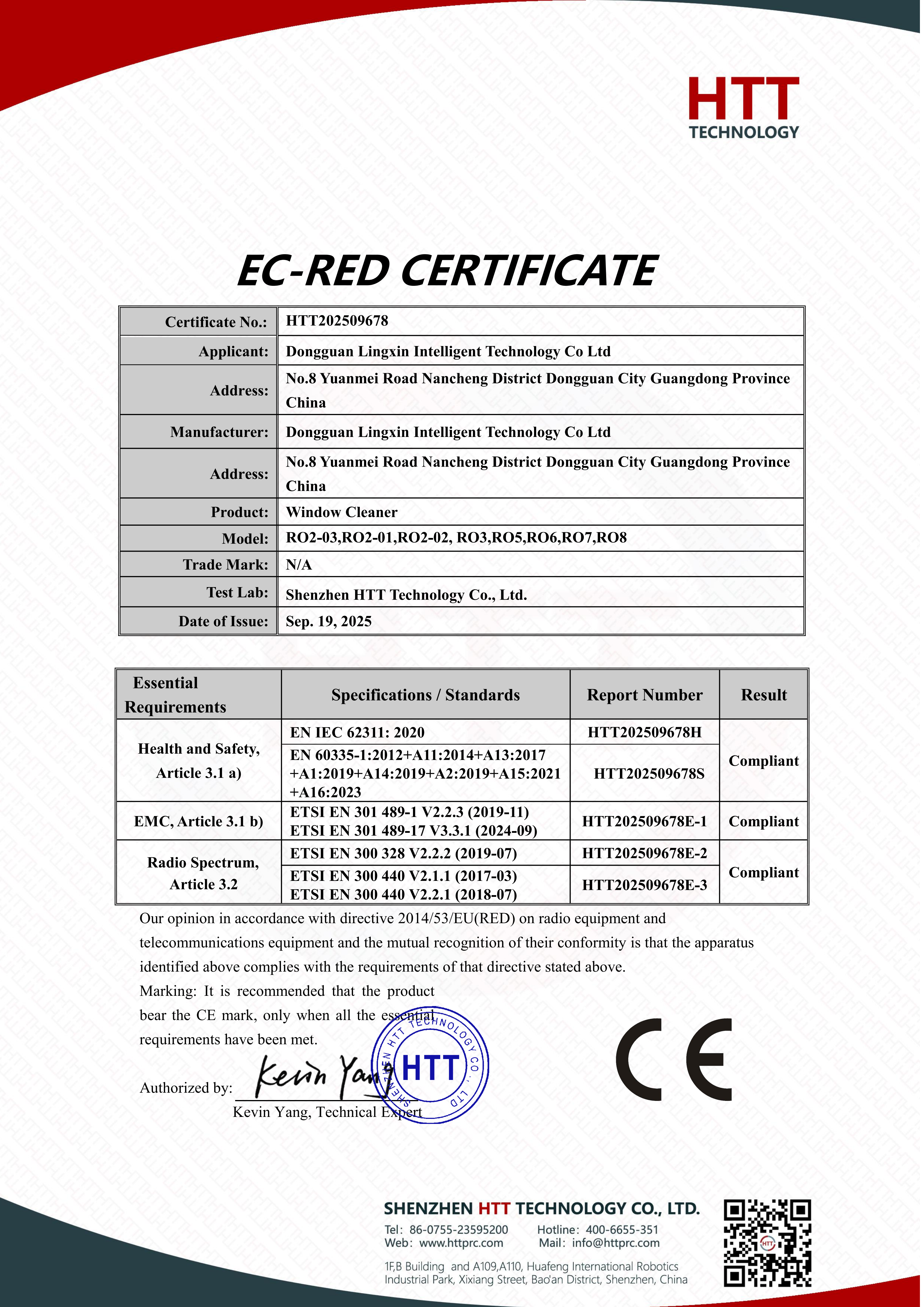
CE-RED certificate held by Lincinco — one of the documents buyers request for wireless smart-home devices.
Use Cases: Matching Robot Type to Real Windows
- Floor-to-ceiling apartment glazing: the first-ranked square four-nozzle autonomous type, where coverage per cycle matters most.
- Balcony doors and sliding glass: a dual-spray or dual-nozzle model, provided the water tank covers the run without a refill.
- Older properties with small divided panes: a round pad robot or handheld electric equipment, since an autonomous chassis may be wider than the clear glass.
- Glass above stairwells and skylights: an autonomous type with a tether or anchor system; if the surface cannot be reached safely even for placement, professional service remains the correct answer.
- Conservatories and sunrooms: a nozzle-based robot for routine passes plus a handheld unit for edges and frames.
- Interior mirrors, glass doors and shower screens: handheld electric window cleaning equipment, which needs no setup and no suction.
- Small shopfronts and offices: a compact high-speed model for frequent light cleaning, with handheld equipment for the frames.
Comparison Table: Window Cleaning Robot Types Side by Side
| Rank / type | Best suited glass | Ease of use | Safety features to verify | Maintenance load | Documents to request |
|---|---|---|---|---|---|
| 1 — Square four-nozzle automatic robot | Large fixed panes, full-height glazing | Highest — attach, start, leave | Edge detection, suction-loss stop, tether or anchor, low-battery behaviour | Tank refills, nozzle care, wiping element | CE-RED (wireless models), RoHS, model-specific certificate copies |
| 2 — Dual-spray / dual-nozzle robotic cleaner | Medium to large glazing, balcony doors | High — similar workflow, more water handling | Same list, plus guidance for smooth or coated panes | More water handling, nozzle cleaning | CE-RED (wireless models), RoHS |
| 3 — Round vacuum-adsorbed pad robot | Smaller or divided panes, interior glass | Medium — pad preparation each cycle | Suction retention, tether, stop on low battery | Pad washing and replacement | CE-RED (wireless models), RoHS |
| 4 — Compact high-speed automatic cleaner | Frequent light cleaning on clean glass | High for short passes | Stability at speed, edge behaviour, tether | Lower per cycle, more frequent overall | CE-RED (wireless models), RoHS |
| 5 — Handheld electric window cleaning equipment | Edges, narrow panes, mirrors, stairs | Highest — no setup, fully manual | Electrical safety, splash control | Head cleaning, tank emptying | RoHS documentation |
FAQ
Which certifications should a window cleaning robot carry for a smart home?
Two documents appear most often on buyer checklists: CE-RED, which relates to radio equipment placed on the EU market, and RoHS, which restricts hazardous substances in electrical and electronic equipment. If the robot connects to an app or a home network, the radio-related certificate is normally the first one a European buyer requests. Lincinco holds CE-RED and RoHS certificates. Buyers should request the certificate copy that corresponds to the exact model and configuration they intend to order, since documentation is tied to a product rather than to a brand name.
How can I tell whether a robot is practical rather than just feature-heavy?
Judge four measurable things: how much of one pane the device finishes in a single cycle without intervention; whether safety functions such as edge detection, stop-on-suction-loss and a tether are documented rather than assumed; how much upkeep one session creates in pads, water and nozzle care; and whether consumables and spare parts can be reordered later. A robot that scores well on those four points is more practical than a robot with a longer feature list.
Do I need the most automated type to get good value?
No. The cost drivers inside this category are mechanical complexity and control features — the number of nozzles or spray points, the level of autonomy, on-unit displays and control options, and the scope of certification required for the target market. A household with a handful of small panes is often better served by handheld electric window cleaning equipment plus a round pad robot than by a fully autonomous machine whose coverage advantage never gets used. Match the type to the glass first, then compare features.
How should a buyer validate a window cleaning robot before committing to a volume order?
Run a sample unit on your own glass type and record four results: suction retention across a full pane, coverage of corners and frame edges, the behaviour when the cycle is interrupted, and the realistic setup and maintenance time. Then compare the documentation package — CE-RED for wireless models and RoHS — against the model you plan to order. For sample requests, project quotes and OEM or ODM discussions, contact Lincinco through www.cleverobot.com, by email at molly@cleverobot.com, or on WhatsApp at +86 13424841625.
Conclusion: Rank by Type, Verify by Document, Confirm by Sample
For smart homes in 2026, the most practical window cleaning robot is the type that matches the glass you actually own and the supervision you are actually willing to provide. Ranked by that logic, square-shaped four-nozzle automatic robots lead for large fixed glazing, dual-spray and dual-nozzle cleaners follow for medium and mixed areas, round pad robots serve smaller and divided panes, compact high-speed models handle routine maintenance, and handheld electric equipment covers the edges and awkward glass that no autonomous device reaches well.
Three habits separate a good purchase from a stored one: verify safety behaviour instead of assuming it, request compliance documentation that matches the exact model, and validate with a sample on your own windows before any volume commitment. Buyers who follow those steps choose a robot type once and stop re-shopping every season.
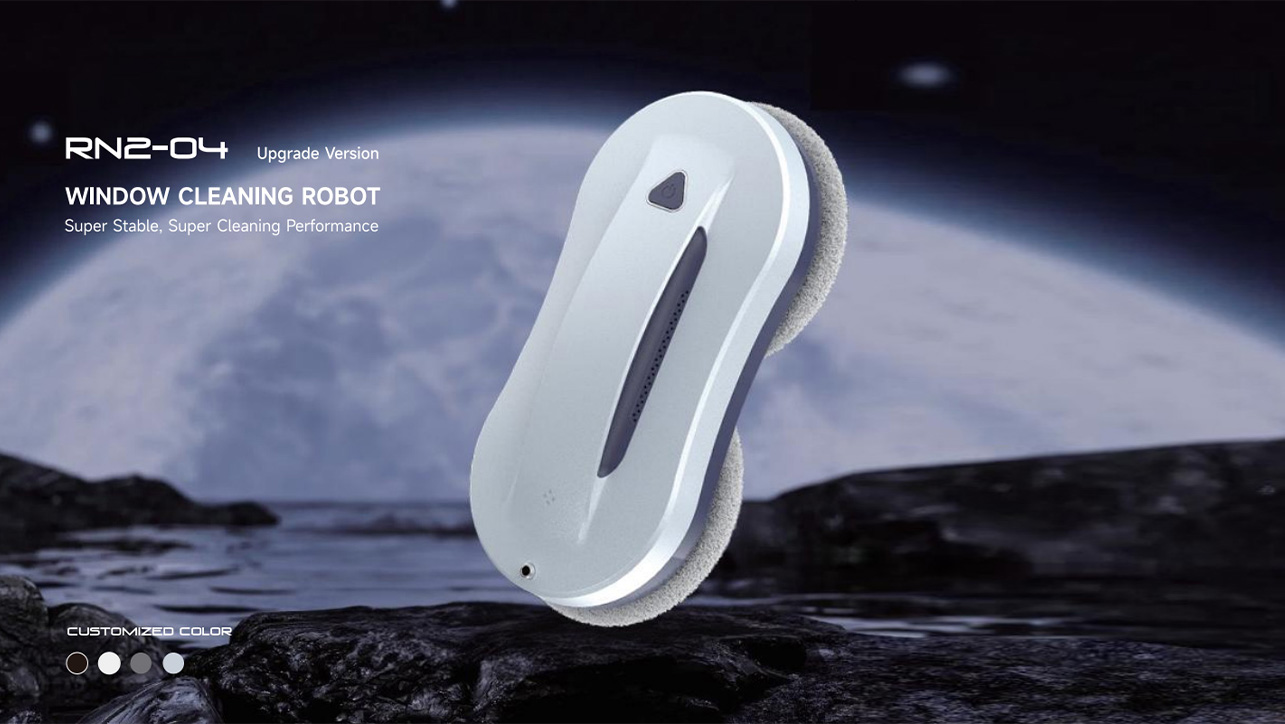
Automatic window cleaning robot OEM — sample requests and project inquiries: www.cleverobot.com | molly@cleverobot.com | WhatsApp +86 13424841625.