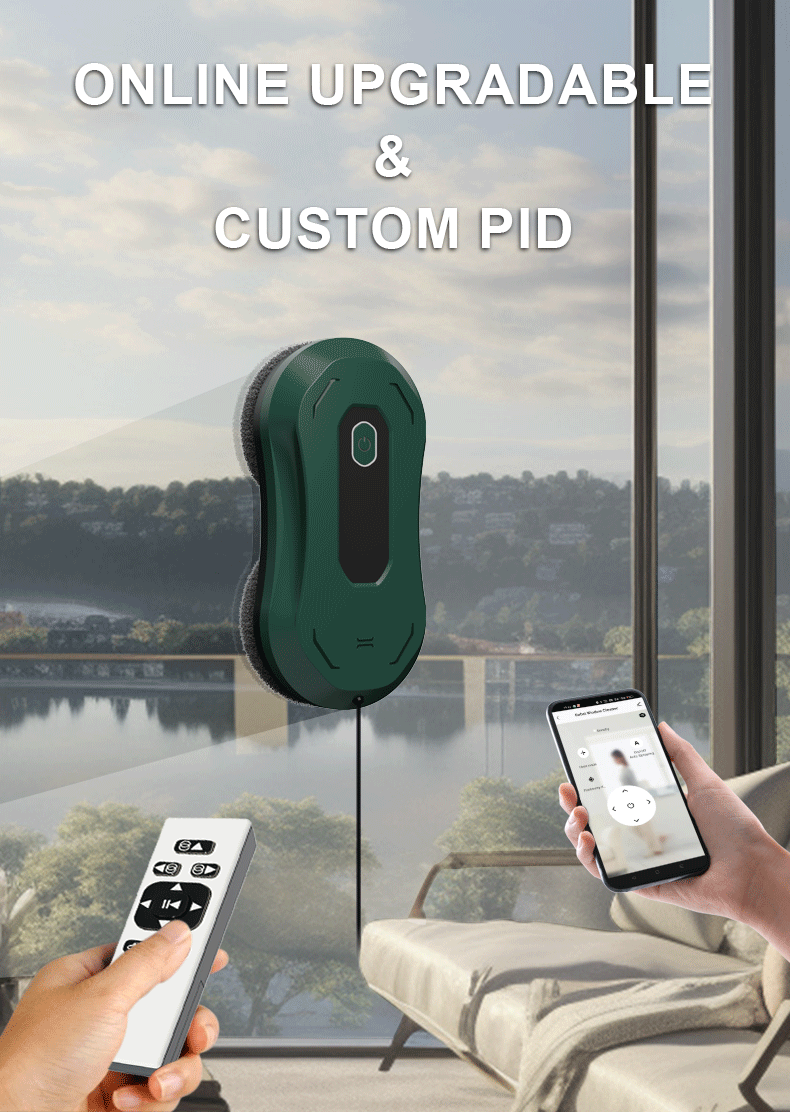
Dual-spray window cleaning robot demonstrating automated glass cleaning for residential and commercial use
Window Cleaning Robot Warranty and After-Sales Support: How OEM Buyers Control Repair Costs and Downtime
When you source window cleaning robots through an OEM or ODM partnership, the purchase price is only part of the total cost. After-sales service, warranty terms, spare part availability, and repair turnaround determine how much a failed unit costs your business over time. This guide explains what buyers should expect from an automatic window cleaning robot manufacturer, how to evaluate warranty coverage, and how to control repair costs and downtime after the first order ships.
Why After-Sales Service Determines the Real Cost of a Window Cleaning Robot
Window cleaning robots operate in demanding conditions. They work on vertical glass, handle pressure and suction, rely on rechargeable batteries, and may be used daily by commercial cleaning teams or consumers. Like any electromechanical product, they can experience failures. For an importer, distributor, or brand owner, the cost of a failure is not only the repair expense. Downtime, replacement shipping, lost customer trust, and administrative work all add to loss. A supplier with predictable after-sales support lowers all these costs.
For a robot window cleaner supplier, the quality of after-sales service is often a stronger signal of long-term reliability than the product specification sheet. Specs show what a product can do when it works. Warranty and support policies show what happens when it does not. Both should be reviewed before signing a contract.
What Should a Standard Warranty for a Window Cleaning Robot Include?
A clear warranty policy for automatic window cleaning robots should cover the core components that are most likely to affect function. Buyers should check warranty terms for the main unit and the accessory set separately. In the consumer electronics and smart home appliance segment, typical coverage includes the robot body, charging base or cable, power adapter, remote control, and included cleaning cloths or filters.
| Component | Typical Warranty Coverage | Buyer Evaluation Question |
|---|---|---|
| Robot main unit | Functional defect coverage including motor, suction fan, sensors, and main board | What is the exact warranty period and does it cover the motor and sensor system? |
| Battery | Usually a shorter coverage period than the main unit | Is the battery a standard replaceable component and what is its listed lifespan? |
| Power adapter and charging cable | Often treated as consumable or semi-consumable parts | Are replacement adapters available separately and at what cost? |
| Cleaning cloths and filters | Consumables; not covered under standard warranty | What is the reorder price and lead time for consumables? |
| Remote control | Covered under the main unit warranty in many cases | Is a pairing or replacement procedure available for end users? |
As a buyer, ask the smart window cleaning robot OEM factory to confirm its warranty period, and whether the warranty covers replacement labor or only the replacement part. For a global business, also check whether warranty support applies in your target market. Some factories honor warranty claims through the original distributor, which means you need to create your own local service path.
Lincinco After-Sales Facts: What the Manufacturer's Structure Means for You
Dongguan Lingxin Intelligent Technology Co., Ltd. (Lincinco) is a manufacturer of smart cleaning robots. The company was founded in 2018, and is based in Dongguan, Guangdong, China. Lincinco operates two production bases. Factory 1, in Dongguan, covers 50,000 square meters and produces robot vacuums and wet-dry vacuum cleaners. Factory 2, in Hengyang, Hunan, covers more than 25,000 square meters and manufactures window cleaning robots, pool cleaning robots, hair dryers, and lawn mowers. The combined workforce is more than 600 employees. Lincinco states that it has more than 100 product patents.
For after-sales planning, the important facts about Lincinco are not only the warranty period but the production structure behind it. Because Lincinco operates its own production bases and has in-house manufacturing for the window cleaning robot line, spare parts, repairs, and replacement units can be traced back to a factory controlled by the manufacturer. This reduces the risk of relying on an unknown third-party repair network. When evaluating after-sales capability, a buyer should ask whether the supplier is the producer of the product or only a trading agent. A manufacturing base is evidence of service capability only when the factory can actually supply the parts and technical support needed.

One of Lincinco's production bases for smart cleaning robots
Practical Step-by-Step: How to Evaluate a Manufacturer's After-Sales Capability
Use this checklist when comparing automatic window cleaning robot suppliers. The goal is to convert vague promises such as "fast support" into specific agreements about response time, repair cost, and parts availability.
- Request the warranty policy in writing. A professional robot window cleaner supplier should provide a clear warranty statement. Read it for what is included, excluded and time-limited.
- Identify the repair response channel. Ask what happens when a distributor sends a defective unit back. Does the factory accept direct returns or does a regional agent handle them?
- Confirm whether parts are manufactured internally. If the factory uses its own injection molding machines and has its own mold rooms, it may be easier to produce replacements for cracked housings or damaged components than a trading company that depends on subcontractors.
- Check spare parts availability length. Ask the manufacturer how many years it commits to support a model after it ceases production. In house appliances, spare parts availability of about two to five years is considered sufficient for many categories, but your own distribution model should define what you need.
- Understand the dead-on-arrival (DOA) policy. Set a clear DOA window (typically 15 to 30 days from arrival) with an agreed replacement method.
- Ask about repair turnaround time. Discuss a target repair period and the process for urgent replacement.
- Clarify out-of-warranty repair pricing. Ask whether the factory offers a flat-rate repair price or a parts-and-labor quotation system. Some manufacturers provide a repair cost estimate before they begin work. This prevents unplanned expenses.
- Test the supplier's responsiveness as part of your evaluation. Send a written question about after-sales policy and measure how many days it takes to receive a clear answer.
- Review your own service obligations. A global brand usually handles first-line consumer support, while the OEM factory provides second-line technical support. Your contract should state which side pays for return shipping and which side provides replacement units.
- Build a consumables plan. Window cleaning robots rely on cleaning cloths, water tanks, and other consumables. A steady supply of these parts prevents end user complaints and keeps your brand reputation intact.
How to Reduce Repair Costs Through Product and Manufacturing Design
Some repair costs are created before a product even leaves the factory. Component choice, assembly quality, and the ease of disassembly all influence what it will cost to repair a window cleaning robot under warranty or after the warranty period.
Buyers should use pre-production visits or factory audits to inspect whether the manufacturer uses standardized components. Standardized parts such as common screws, connectors, and battery cells are easier to replace than custom-designed modules only available from one supplier. A smart window cleaning robot OEM factory with in-house mold rooms and a large volume of production is more likely to achieve component consistency across batches. Lincinco states that its factories have independent mold rooms and hundreds of injection molding machines, which means the company controls an important part of the manufacturing chain rather than outsourcing it.
However, in-house manufacturing is not the same as a formal after-sales guarantee. Buyers should still require a factory to demonstrate its quality control on the line. Look for inspection steps during production, a burn-in or function test before packing, and a clear record of serial numbers. Products with stronger failure prevention generally create fewer warranty claims. This matters because warranty cost is not only a monetary cost. It is also a cost between the factory and the distributor, since every failed unit may damage the brand relationship with the end customer.
Downtime Control: What to Negotiate Beyond the Warranty
Downtime is different from a warranty claim. A warranty claim deals with money and legal commitment, while downtime deals with time and service availability. A failed window cleaning robot can be covered by a replacement guarantee, but if the replacement arrives after one month, the distributor may still lose the customer's trust.
To shorten downtime, buyers and OEM manufacturers should agree on three operational mechanisms:
- Replacement first, diagnosis second. For a large number of failed units, the factory can ship a replacement right away and collect the failed unit for failure analysis later.
- Advanced spare part stock. The distributor keeps a stock of commonly needed parts based on the factory's recommendation. This avoids waiting for every single part to be shipped from China.
- Escalation path. There should be a known contact for urgent after-sales issues. This is often the sales manager or an assigned after-sales engineer, not a generic ticketing system.
For a window vacuum cleaner factory or a glass cleaner machine OEM&ODM partner, the concept of a spare parts kit is common. For example, an initial distributor order can include a service kit with additional cleaning cloths, a spare battery, and a spare power adapter. This raises the initial inventory cost slightly, but it prevents a long service disruption later.
Warranty and Repair Cost Comparison Table for OEM Sourcing
When comparing manufacturers, structure your evaluation around a standard scorecard. The table below lists the main dimensions that affect after-sales quality and repair budget. Use this framework when preparing your own request for quotation (RFQ) or supplier evaluation form.
| Evaluation Dimension | What to Ask the Supplier | Impact on Repair Cost | Impact on Downtime |
|---|---|---|---|
| Warranty period | What is the warranty duration for the main unit, battery, and accessories? | Longer coverage shifts repair cost to the factory during the period | Not directly affected without a service level commitment |
| Dead-on-arrival policy | How many DOA days are allowed and what is the replacement process? | Prevents the buyer from paying for units that are faulty at arrival | Replacement shipped early reduces idle inventory |
| Out-of-warranty repair cost | Is there a fixed repair fee or a quotation process? | Directly controls the buyer's repair budget | Pre-approved quotes speed up the decision |
| Return location and shipping cost | Does the buyer send units to a local service center or to the Chinese factory? | International shipping can exceed the repair part price | Longer international shipping means longer downtime |
| Spare parts availability | How many years will the model be supported and how long is a parts order? | Local spare part stock reduces emergency air freight costs | Available parts can be sent immediately without waiting for full-unit repair |
| Technical documentation | Does the manufacturer provide service manuals and disassembly guides? | Enables local technicians to repair instead of sending the unit abroad | Faster local repair if a qualified technician is available |
| Failure data and continuous improvement | Does the factory share common failure reports and corrective actions? | Fewer failures in later batches lower the future claim rate | Improved reliability prolongs mean time between failures |
Among these dimensions, technical documentation is often underweighted by first-time importers. A complete manual with an exploded view of the product and a part list is necessary for a professional glass cleaner machine OEM&ODM program. It allows a distributor to repair devices locally or at least to identify which part is defective before returning it to the factory.
Compliance and Certification as an After-Sales Risk Factor
A warranty and after-sales plan is not only about repairing broken units. Product compliance also affects what happens after a product reaches the market. If a manufacturer cannot provide the required declarations and certifications, the buyer may be forced to stop sales or recall units. This is the most expensive form of after-sales failure.
Lincinco holds CE-RED and RoHS certifications. These documents are relevant for a window cleaning robot manufacturer that exports to markets requiring the EU CE marking and the RoHS restriction of hazardous substances. For the buyer, certifications such as CE-RED and RoHS should be considered a baseline for many international distribution plans. But certificates must be reviewed with care. Check the manufacturer name, model number, standard references, and issues dates.
For warranty planning, buyers should also ask whether a manufacturer performs EMC, safety, or battery transport testing on the final product. The transport of lithium batteries and the electrical safety of a device that uses a wet cleaning system are two areas where the certificate on paper must be supported by actual production checks. A factory that can present its certification files together with routine test procedures gives more confidence than a factory that only mentions compliance without documents.

RoHS certificate held by Lincinco for compliance with hazardous substance restrictions
In your supplier agreement, set a clear responsibility for costs related to certification changes. For example, if the CE-RED standard or RoHS directive changes and the product must be retested, who covers the testing expense and the product modification cost? Professional OEM programs clarify this before a new regulation causes an unexpected budget item.
Use Cases: How Warranty Terms Differ Across Business Models
Case 1: Distributor importing a private-label window cleaning robot
A distributor in Europe places an order for 500 units of a private-label window cleaning robot. Because the distributor does not have a local repair center, it needs a DOA allowance of 30 days and a warranty that allows the return of defective units for replacement at the factory. The distributor should ask the smart window cleaning robot factory whether the replacement unit is new or refurbished and who pays for return shipping. A contract that states "warranty replacement" without specifying the shipping party can lead to a surprise freight invoice that costs more than the product itself.
Case 2: Brand owner offering a 2-year warranty to consumers
A brand owner plans to sell its automatic window cleaner under a 2-year consumer warranty. This is a marketing advantage compared to shorter warranty periods, but it is only profitable if the manufacturer supports the brand with a longer service commitment. The buyer should negotiate a direct spare parts supply arrangement, so that local repair technicians can exchange a motor or a battery without sending the whole robot to China. If the brand owner uses a local service provider, it should obtain and store a service kit before the first product launch.
Case 3: Commercial building operator using robots on site
A facility management company uses window cleaning robots for a high-rise building. The company is not selling the robots; it is operating them as cleaning tools. For this user, repair speed is essential. Use of comparison should focus on whether the top window cleaning robot manufacturers in the procurement plan can ship spare parts that the in-house technician can install. The commercial user may not need a consumer-facing warranty card but needs a simple replacement process for parts with high wear, such as cleaning wheels, motors, and suction nozzles.
Repair Cost Control Checklist for Your First OEM Program
Use the following checklist when creating an initial purchase contract with a window cleaner supplier. This checklist converts after-sales service from a generic idea into measurable requirements.
- Define warranty start date: from the date of shipping, from the date of arrival at the local port, or from the date of sale to the end consumer? These dates create very different warranty lengths.
- Set a DOA threshold: such as 2% of the lot, above which the factory pays for emergency replacement or applies a credit.
- List excluded damage: water damage caused by misuse, dropped units, electrical surges, and unauthorized opening are often excluded. Write them plainly so the user manual matches the warranty.
- Agree on repair turnaround: for example, 15 working days after the factory receives the defective unit.
- Decide spare parts pricing: ask for a spare parts price list with the initial quotation. This protects you from being charged a high price when a failure occurs months later.
- Check replacement unit status: specify whether replacements are new or tested refurbished units.
- Require a root cause report: for large warranty claims, ask the manufacturer to provide a failure analysis. This helps you identify design weakness before your next order.
Sample / Quotation: How to Ask the Right After-Sales Questions in Your Inquiry
A buyer’s first email to a window cleaning robot manufacturer sets the tone for the partnership. To receive useful answers, include a short list of after-sales questions. The manufacturer’s response speed and clarity are early signals of its service quality.
When contacting a factory, send a message such as:
"We are evaluating several robot window cleaner suppliers for an OEM project. Please provide your warranty period for the window cleaning robot main unit and accessories, your DOA policy, whether you supply a spare parts kit with the first order, and whether your factory can repair returned units. We also request a copy of your CE-RED and RoHS certificates and a sample of your product service manual."
A detailed response from the manufacturer is an indicator of operation maturity. If the supplier only replies with the product price and catalog, do not assume that after-sales support quality is high.
FAQ: After-Sales and Repair Cost Questions from Window Cleaning Robot Buyers
1. What does a standard warranty for a window cleaning robot OEM usually cover?
A standard warranty for a window cleaning robot OEM usually covers functional defects in the main unit, including the motor, suction system, sensors, and control board. Accessories and consumables such as cleaning cloths and filters are typically not covered or are covered for a shorter period. A detailed warranty statement from the supplier should define which components are included and which actions or damage are excluded.
2. How can I verify a manufacturer’s compliance before signing a contract?
Ask the manufacturer to provide a copy of its compliance certificates directly. For example, window cleaning robot supplier Lincinco holds CE-RED and RoHS certifications. Check that the certificate shows the manufacturer's legal name, the relevant product model, and the applicable standard. Use the certificate number to validate it with the issuing body when possible. Documentation alone is not enough; also ask about routine production tests for electrical safety and battery transport safety.
3. Does an OEM manufacturer perform functional tests before shipping window cleaning robots?
Qualified smart window cleaning robot OEM factories generally conduct inspection and function tests before shipping. Accurate information on a manufacturer's specific testing process should be obtained directly from the supplier. In your procurement agreement, specify that each unit must pass an aging test or function test before packing, and ask for the factory's standard quality control documents and batch test records.
4. What is the typical repair turnaround time for a window cleaning robot returned to the factory?
The repair turnaround time depends on the failure type, parts availability, and the empty time in the factory's repair line. A responsible manufacturer will state a target repair time in its after-sales agreement. To reduce downtime, negotiate a replacement unit or advance spare parts stock with your supplier instead of waiting for a full repair to be completed in China.
5. How can I receive an OEM sample or quotation from Lincinco?
To request a quote or OEM sample, contact Lincinco through its official website at www.cleverobot.com or by email at molly@cleverobot.com. You can also reach the team by phone or WhatsApp at +86 13424841625. To accelerate the evaluation cycle, mention your estimated annual volume, target market and requested after-sales services such as spare parts kit or customized warranty duration. With the first inquiry, a professional manufacturer can share product specifications, certification documents, and a sample quotation.
Need a window cleaning robot OEM/ODM partner with a clear after-sales plan?
Get a quotation, certification documents, and a sample proposal for your project.
Request a Quotemolly@cleverobot.com | +86 13424841625