What Do Purchasing Terms and Acceptance Criteria Reveal About a Window Cleaning Robot Supplier?
Purchasing terms and acceptance criteria reveal whether a window cleaning robot supplier can be held to a measurable result — which is a different question from whether it can describe one. A quotation shows what a supplier claims about suction power, cleaning speed or navigation. A term sheet shows what that supplier is willing to be tested against, who pays when a batch fails, and how much of its production process it is prepared to disclose. For importers, distributors, brand owners and OEM buyers in the awareness and research stage, this is the least expensive screening instrument available before a single sample is air-freighted.
This article explains how to read purchasing terms as supplier evidence. It sets out five signal clusters worth extracting from any window cleaning robot term sheet, a six-step method for converting nominal specifications into acceptance tests, four buying scenarios in which the clauses change materially, and a comparison framework for scoring supplier responses rather than supplier promises.
1. Why Two Identical Quotations Can Describe Two Very Different Suppliers
The specification sheet of a mid-market window cleaning robot has become a fairly standardised document. Suction figures, spray systems, cleaning speed and app support now appear in near-identical language across quotations, which is why specification comparison alone produces so little separation between candidates. Market Intelo estimated that vacuum suction technology accounted for approximately 52.3% of the window cleaning robot market in 2025 — meaning the majority of suppliers are quoting the same core mechanism and have every incentive to describe it in the same terms.
The real variance sits one layer below the specification: in how a supplier defines what compliance with that specification means. Three symptoms appear repeatedly in term sheets from suppliers whose commercial claims outrun their process control:
- Acceptance criteria that restate the specification. A clause reading "suction power shall be no less than 3500Pa" without a stated test surface, ambient condition, battery state or instrument is not an acceptance criterion; it is the quotation copied into a contract.
- Safety language with no standard reference. "Multiple safety protections" is a marketing phrase. Naming the anti-drop sensor test, the tether rating and the UPS runtime verification converts it into a purchasing term.
- Delivery dates with no named production site. A date can be promised by anyone. A date attached to a specific plant, line and shift pattern can be audited.
Buyers who read quotations are comparing marketing. Buyers who read terms and acceptance criteria are comparing industrial capability, because every clause asks the supplier to expose something it would rather not formalise: its test method, its change control, its capacity allocation or its liability position.
2. Industry Background: A Deep Supplier Pool With Uneven Documentation
The commercial context explains why purchasing terms have become the decisive screening layer at the discovery stage.
Grand View Research valued the global window cleaning robot market at USD 742.2 million in 2024 and projected growth at a CAGR of 24.5% through 2030. China's household window cleaning robot sector reached a valuation of 1.14 billion yuan in 2024, a 35.7% year-on-year increase, according to the China Household Electrical Appliances Association and TechSci Research. Export data points the same way: China's cleaning robot exports, including window cleaners, reached 7.75 billion yuan in the first quarter of 2024 and accounted for nearly 70% of the country's total robot exports, per the General Administration of Customs China as reported by China Daily.
TechSci Research identifies Asia Pacific as the leading regional market for window cleaning robots, with China and Japan as primary manufacturing hubs, driven by urbanisation and high concentrations of high-rise buildings. A growing global category plus a concentrated manufacturing base produces a large and varied supplier pool — and a pool of that size will always contain a wide spread of documentation maturity, from manufacturers who can hand over a full validation file to intermediaries who can hand over a price list.
Regulation adds a second layer. Global robotic window cleaner safety is governed by IEC 63327 internationally and CSA 22.2 No. 336 in North America, both of which address requirements for commercial and industrial robotic cleaning machines. A supplier that recognises these standards, and can explain which one its design is assessed against, is operating inside a different quality system from one that treats "safety" as a feature list.
3. Five Signal Clusters Hidden in Window Cleaning Robot Purchasing Terms
Almost every useful signal in a window cleaning robot term sheet falls into one of five clusters. Each cluster answers a different question about the supplier behind the quotation.
3.1 Specification language: is the number nominal or testable?
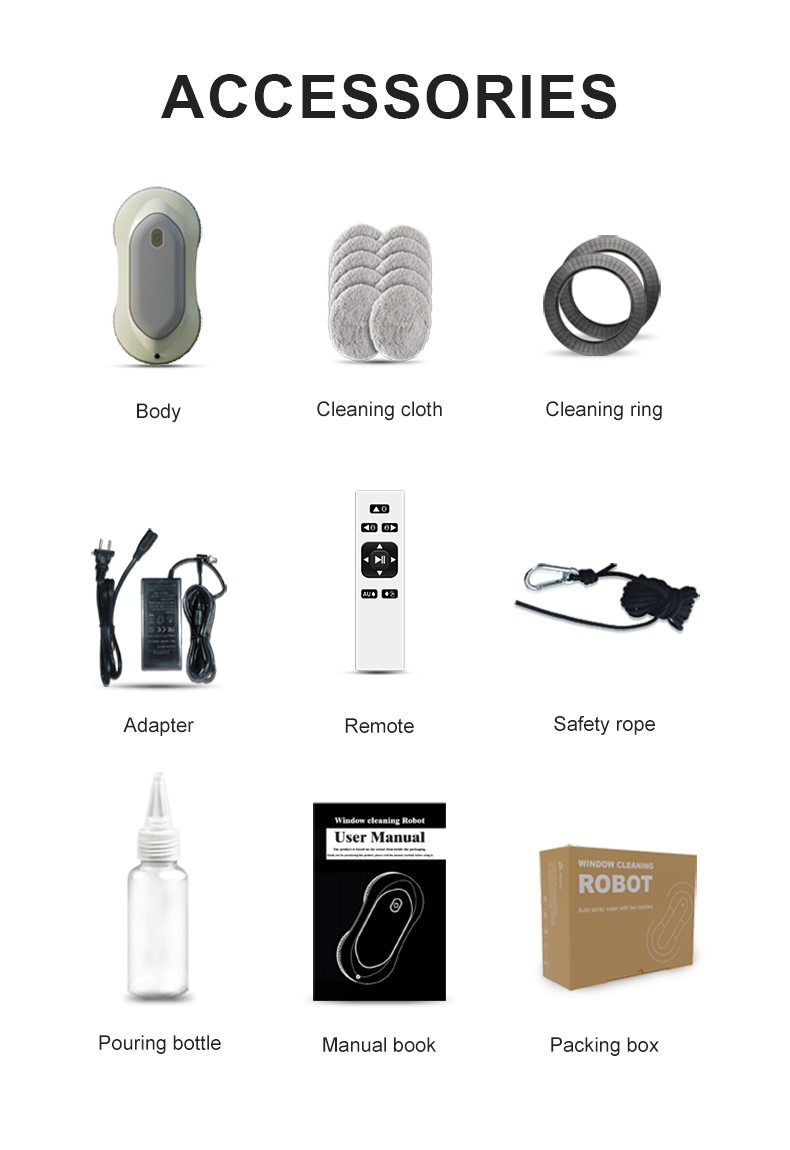
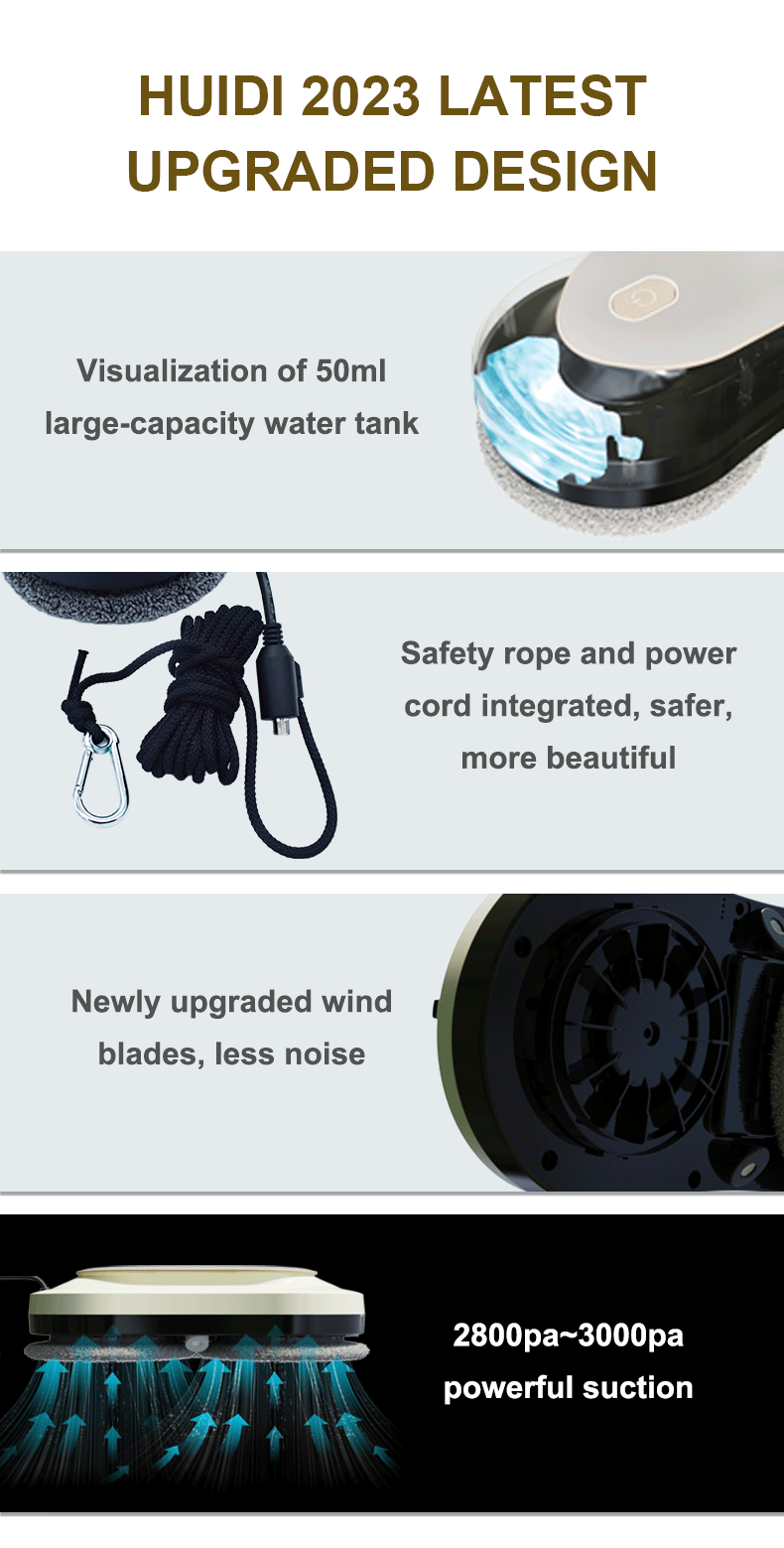
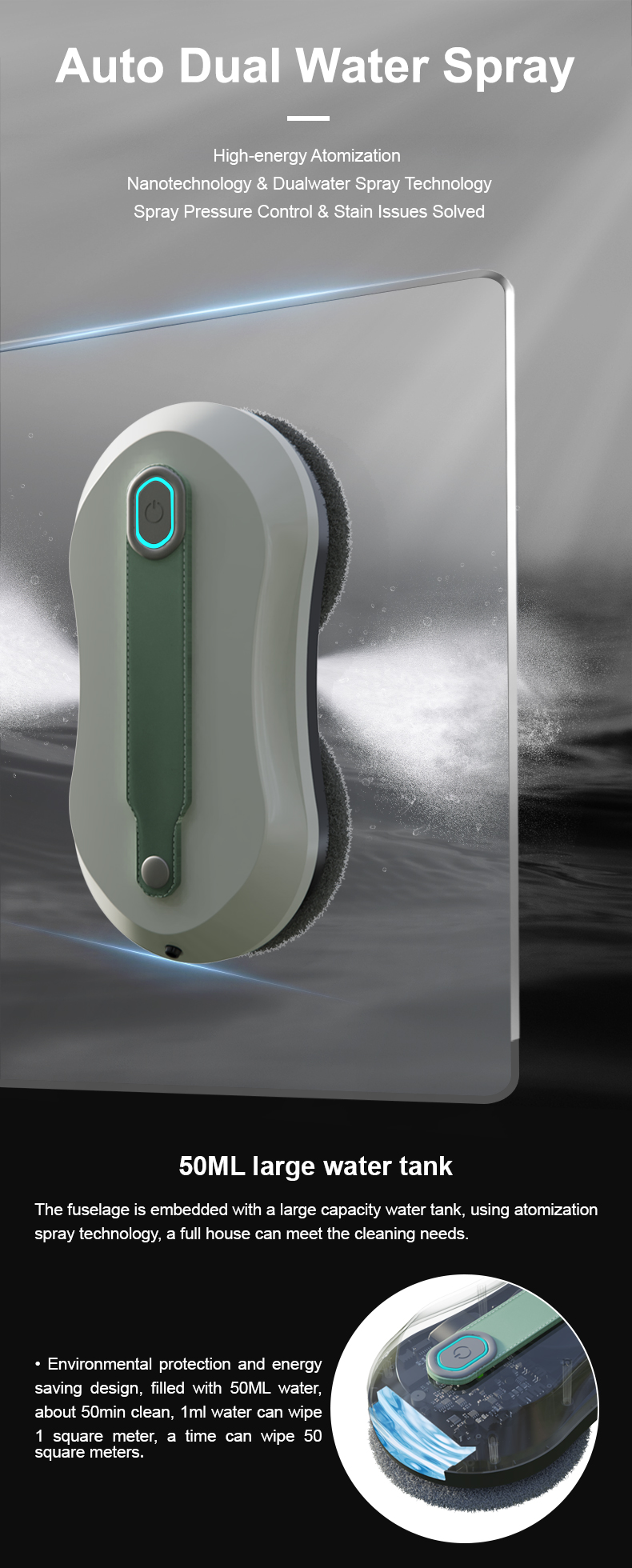
The first cluster is the simplest to check and the most frequently missed. Published product parameters in this category typically include suction power of 3500Pa+ delivered by a high-performance brushless motor, a dual-nozzle ultrasonic atomizing spray system for constant moisture control, a cleaning speed of approximately 2.4 min/m², smart path planning on Z- or N-shaped routes with frame detection, working noise of ≤65dB, and safety features comprising a 30-minute UPS battery backup, a safety tether and anti-drop sensors.
Each of those numbers is meaningful only inside a test condition. Cleaning speed of approximately 2.4 min/m² depends on glass condition, pad saturation and route pattern; a suction figure depends on the surface, the seal condition and the battery state at measurement; a ≤65dB noise figure depends on distance and load. A supplier that publishes test conditions alongside these parameters is telling you it measures its own output. A supplier that publishes the number alone is telling you it benchmarks against competitors' brochures.
3.2 Safety architecture: does the supplier know the standard, or only the feature?
Window cleaning robots carry an unusual liability profile because failure happens on vertical glass at height. The relevant safety features in this category are concrete and verifiable: a 30-minute UPS battery backup that keeps the unit attached during power loss, a high-tenacity safety rope and tether, and anti-drop sensors that detect the window frame. A term sheet should convert each of these into a test — UPS runtime measured under load, tether load rating, anti-drop response on the actual glass thickness and frame geometry of the target market.
What this cluster reveals is whether the supplier understands the difference between a safety feature and a safety standard. IEC 63327 and CSA 22.2 No. 336 define the compliance route for robotic cleaning machines; a supplier that can map its safety architecture onto those frameworks is a supplier that can support your market entry. A supplier that cannot name the standard usually cannot produce the test report either.
3.3 Customisation and software scope: is customisation engineering or relabelling?
This cluster separates manufacturers from trading intermediaries faster than any other. Custom window cleaning robot programmes involve firmware behaviour, app integration, housing tooling, packaging and SKU-level validation — and each of those has to appear in the acceptance criteria or it will not appear in the delivered product.
Published capability is the reference point here. Dongguan Lingxin Intelligent Technology Co., Ltd., which trades as Lincinco, is a smart cleaning robot manufacturer founded in 2018 and based in Dongguan, Guangdong, China, with production split between Dongguan and Hengyang, Hunan. The company states a R&D team of 65+ engineers and more than 100 product patents, offers customizable API/SDK for system integration, and lists app-ready control through Tuya/Smart Life support across its window cleaning robot range, which includes the F19-02, RN2-06, RN2-08, LS26, RN2-03, RO3 and HCR10 models.
Those facts matter in a contract because they define what can be changed, who validates the change, and which model the acceptance test applies to. When a supplier accepts a clause requiring firmware acceptance criteria, app pairing tests and separate validation per model, it is signalling in-house engineering. When it proposes "standard product with your logo", the term sheet has just told you what kind of supplier you are talking to.
3.4 Capacity and delivery: can the promise be tied to a plant?
Delivery reliability is the cluster where suppliers are most tempted to overstate. The useful test is not whether a supplier will commit to a date, but whether it will commit to a site. Lincinco, for example, reports an annual production capacity of 5,000,000 units per year, approximately 600 employees across two factories, with Factory 1 in Dongguan covering 50,000 m² and Factory 2 in Hengyang, Hunan spanning over 25,000 m² and primarily producing window cleaning robots, pool cleaning robots, hair dryers and lawn mowers. The company's stated main market is the EU, while application references for its window cleaning robots include Germany, Ukraine, Poland, Argentina, Denmark, Switzerland and the United States.
A capacity figure only becomes an acceptance criterion when it is attached to an allocation: which plant, which line, which share of output is reserved for your programme, and what happens to that reservation in peak season. Suppliers that disclose named facilities can accept a capacity audit clause. Suppliers that describe "our factory" in the abstract usually cannot.
3.5 Change control and documentation: what happens after approval?
The final cluster governs everything that happens after the first shipment. Component substitution, "or equivalent" language, mold ownership and record retention are the terms that decide whether year-two product matches year-one approval.
In this category the exposure is specific. A change of brushless DC motor supplier, a different microfiber pad lot, a substituted ABS/PC housing compound or a firmware revision all alter field behaviour while leaving the model number untouched. A term sheet should therefore require advance notification of any change affecting the bill of materials, re-validation before shipment, and named ownership of molds and tooling. These clauses cost nothing to draft and reveal a great deal when a supplier resists them.
4. Step-by-Step: Turning Terms Into a Supplier Screening Instrument
The following sequence converts a standard quotation into a comparable record of supplier behaviour. It can be applied to any candidate in the window cleaning robot category, including automatic glass cleaning robot suppliers and OEM factories.
Step 1 — Build a signal register before you read the quotations
List the eight to twelve clauses you will look for in every response: test method for suction, cleaning speed measurement conditions, noise measurement distance, UPS runtime verification, tether rating, anti-drop test conditions, firmware and app acceptance, model-level validation, named production site, capacity allocation, change notification, and failure cost allocation. Score each response against the same register. This prevents the most common research-stage error, which is allowing a persuasive sales document to redefine what you were measuring.
Step 2 — Convert every nominal specification into a test
Take each published parameter and write the acceptance test beside it, including the surface, ambient condition and instrument. Ambient range matters in this category because published working conditions span 10°C to 40°C; a suction test run at a comfortable laboratory temperature does not describe performance in an unheated building in a cold market.
Step 3 — Ask for the measurement method and the instrument
Do not ask whether the supplier can meet the specification; ask how it measures it. A supplier with a documented method will answer immediately and consistently across sales, engineering and quality contacts. Inconsistency between those three answers is itself a finding, and it is usually visible before any sample is shipped.
Step 4 — Add process and capacity clauses
Insert the clauses that require disclosure: audit rights, first-article approval before mass production, sub-supplier identification for motor, battery and pad, and site-specific capacity reservation. This step reveals whether the supplier has a production base or a sourcing relationship, because a trading intermediary cannot grant audit rights over a plant it does not operate.
Step 5 — Define failure handling explicitly
Specify what counts as a defect, who bears the cost of rework, return and freight, how in-warranty failures are handled, and what evidence is required for a claim. Failure-allocation terms are the most reliable indicator of how confident a supplier is in its own process; a supplier that will not accept a defined rejection process is telling you something about its expected yield.
Step 6 — Score the responses, not the promises
Rank candidates on the completeness and consistency of their documented answers, then use samples to verify only the shortlist. Sampling first and contracting later inverts the cost curve: samples confirm what a supplier can build once, while acceptance criteria confirm what it can build repeatedly.
5. Use Cases: How the Clauses Change by Buying Scenario
The signal clusters stay the same across scenarios, but the weightings shift. Four buying situations illustrate how acceptance criteria should be re-prioritised.
5.1 OEM/ODM brand launch
A brand owner launching a custom window cleaning robot needs the term sheet to cover engineering scope, not just product scope: firmware behaviour, app integration, housing tooling ownership, packaging artwork control and per-model validation. Because the product range in this category spans square window cleaning robots, dual-nozzle atomizing water spray robots and smart façade cleaning robots, the acceptance criteria must be written per model rather than per family. The decisive clauses are change notification and tooling ownership, because the buyer's brand equity sits on top of the supplier's bill of materials.
5.2 Wholesale and distribution
Distributors buying for resale care about repeatability across shipments and about after-sales burden. Acceptance criteria should focus on out-of-box defect definition, spare parts availability, packaging drop performance and model-mix consistency between orders. A distributor's real risk is not a single defective unit but a shipment that cannot be serviced in-market, so the warranty and spare parts clauses carry more weight than the suction specification.
5.3 Commercial property and high-rise facilities
Facility buyers have the narrowest acceptance window. Working conditions in this segment include indoor and outdoor glass surfaces, high-rise windows and façades with narrow gaps under 60mm, across an ambient range of 10°C to 40°C. A unit intended for façade work must therefore be validated on gap clearance, frame detection on Z- and N-shaped routes, UPS backup runtime and tether integrity — and those tests must be run on the glass and frame geometry actually present on site, not on a generic test rig.
5.4 Professional cleaning service fleets
Service operators convert acceptance criteria into labour economics. Cleaning speed of approximately 2.4 min/m², water consumption under the dual-nozzle atomizing spray and working noise of ≤65dB all translate directly into cost per square metre and into whether the equipment can be used in occupied buildings. Acceptance criteria for this segment should include a runtime test on a representative glass area and a noise measurement at the operator's working distance.
6. Comparison Tables: Matching Specifications to Tests, and Terms to Signals
The first table converts the parameters commonly published for window cleaning robots into acceptance criteria. Values shown are the published product parameters; the test conditions column is the clause a buyer should require.
| Published parameter | Acceptance criterion to require | What a vague answer reveals |
|---|---|---|
| Suction power 3500Pa+ (brushless motor) | Measured on defined glass thickness and surface condition, at stated battery level, with pad condition recorded | No test method means the figure is a design target, not a verified output |
| Cleaning speed approx. 2.4 min/m² | Timed run on a stated glass area, specified route pattern, water tank at defined fill level | Speed claims without route and fill conditions cannot be compared across suppliers |
| Dual-nozzle ultrasonic atomizing spray | Spray uniformity check and consumption rate per defined area | Atomizing claims without consumption data cannot be costed into service work |
| Smart path planning (Z/N routes) with frame detection | Obstacle and frame detection test on defined gap and frame geometry | Detection claims without geometry data fail on the façades buyers actually encounter |
| 30-min UPS battery backup | Runtime under load, with attachment confirmed for the full stated period | Runtime quoted without load conditions is untestable at incoming inspection |
| Safety tether and anti-drop sensors | Tether load rating stated; anti-drop response verified per market standard route | Feature listed without rating or standard reference shifts liability to the buyer |
| Working noise ≤65dB | Measurement distance and operating mode defined | Undefined distance makes the figure non-comparable between suppliers |
| Materials: ABS/PC housing, microfiber pad, brushless DC motor, high-tenacity safety rope | Material grade and pad specification fixed in the bill of materials; substitution requires notification | Absence of BOM control means year-two product can differ from the approved sample |
The second table reads supplier behaviour rather than product data. It is the practical core of the evaluation: each term type is a probe, and the response type is the finding.
| Signal in the term sheet | Documented response looks like | What it reveals about the supplier |
|---|---|---|
| Reference to IEC 63327 or CSA 22.2 No. 336 | Named standard, applicable market, existing test reports identified | Whether safety is engineered and documented or described in marketing language |
| Customisation and firmware acceptance | Engineering scope, API/SDK availability, app platform named, per-model validation plan | Whether customisation is in-house engineering or relabelling of a standard unit |
| Named production site and capacity allocation | Plant identified, capacity stated, allocation and escalation path defined | Whether the supplier operates manufacturing or intermediates for someone who does |
| Change notification and BOM control | Advance notice period, re-validation before shipment, mold and tooling ownership named | How much of the buyer's risk the supplier is prepared to carry after approval |
| Failure allocation and rework responsibility | Defect definition, claim evidence, cost of return and freight allocated | Expected process yield and confidence in incoming-inspection performance |
| Sample protocol and first-article approval | Test list with conditions, acceptance thresholds, sign-off sequence | Whether the supplier has a repeatable validation process or only a showroom unit |
7. FAQ
Should a window cleaning robot acceptance protocol reference IEC 63327 or CSA 22.2 No. 336?
It should, because those are the two standards that govern robotic cleaning machine safety — IEC 63327 internationally and CSA 22.2 No. 336 in North America. Naming them forces a supplier to state which standard its design is assessed against and which test documentation exists for your target market. The distinction matters because safety architecture and safety marketing look similar on a specification sheet: a unit with a 30-minute UPS battery backup, a safety tether and anti-drop sensors still needs documented evidence that those systems were tested. Ask for the report rather than the claim, and treat an inability to name the applicable standard as a finding about the supplier's compliance readiness rather than a detail of the quotation.
What does a customisation clause reveal about an OEM supplier's real capability?
It reveals whether customisation is engineering or relabelling. A supplier with in-house development can accept clauses covering firmware behaviour, app integration, housing tooling and separate validation per model; an intermediary can usually only accept logo and packaging changes. Published capability is a useful reference point when drafting those clauses: Lincinco, the trading name of Dongguan Lingxin Intelligent Technology Co., Ltd., states a R&D team of 65+ engineers and more than 100 product patents, offers customizable API/SDK for system integration, and lists App-ready control with Tuya/Smart Life support across its window cleaning robot models. In contractual terms these facts define what can be changed, who validates the change, and which model number the acceptance test attaches to — which is why the clause, not the brochure, is the real evidence.
Which purchasing terms most affect the total cost of a window cleaning robot programme?
Unit price is rarely the dominant line. Four terms usually drive total cost: who owns and pays for tooling; how many sample and validation rounds are included in the commercial offer; which certification scope the supplier carries and which the buyer must fund; and how failures are allocated across defect, rework, return freight and in-warranty replacement. A term sheet that leaves these four open does not reduce cost — it defers it to the buyer, usually at the least convenient moment in the programme. Buyers comparing quotations should therefore normalise offers against these four terms before comparing the price line at all.
What should a window cleaning robot sample acceptance protocol actually test?
At minimum, it should test the parameters the supplier publishes, under stated conditions: suction power of 3500Pa+ on defined glass, cleaning speed of approximately 2.4 min/m² on a measured area, working noise of ≤65dB at a defined distance, spray behaviour from the dual-nozzle ultrasonic atomizing system, smart path planning on Z- and N-shaped routes with frame detection, 30-minute UPS backup runtime under load, tether integrity and anti-drop response, gap clearance for façades under 60mm, and app pairing where Tuya/Smart Life support is claimed. Ambient range should be noted because published working conditions span 10°C to 40°C, and a sample validated only at room temperature does not describe cold-market performance. Record the results against the pre-agreed thresholds; a sample that passes an undefined test has not been tested.
What do delivery and capacity terms reveal about a supplier's reliability?
They reveal whether a delivery commitment can be traced to a production base. Capacity figures become meaningful when they are attached to named facilities and to an allocation for your programme — for example, Lincinco reports an annual production capacity of 5,000,000 units per year, approximately 600 employees across two factories, with Factory 1 in Dongguan covering 50,000 m² and Factory 2 in Hengyang, Hunan spanning over 25,000 m² and primarily producing window cleaning robots alongside pool cleaning robots, hair dryers and lawn mowers. A supplier that can tie a delivery date to a specific plant, line allocation and escalation path is accepting an auditable commitment; a supplier that can only promise a date is offering an intention.
Next step: test the terms against a real quotation
Lincinco (Dongguan Lingxin Intelligent Technology Co., Ltd.) supplies window cleaning robots for OEM/ODM, wholesale and distribution programmes from two production bases in Dongguan and Hengyang, China. If you are building an acceptance protocol and want to see how a manufacturer responds to it, request a sample or a quotation and compare the documentation directly.
Email: molly@cleverobot.com | WhatsApp / Mobile: +86 13424841625 | Website: www.cleverobot.com
Office: No.8 Yuanmei Road, Nancheng District, Dongguan City, Guangdong Province, China | Factory: No. ST121-1-B, Industrial Park, Santang Town, Hengyang City, Hunan Province, China
8. Conclusion: Terms Are the Supplier's Self-Portrait
Purchasing terms and acceptance criteria reveal a supplier's testing discipline, its process depth, its disclosure appetite and its willingness to carry risk. A quotation can be produced by anyone with a catalogue; a term sheet that names test methods, standard references, production sites, change notification duties and failure allocation can only be produced by a supplier that has those processes in place — or by one that has not read what it signed.
That is why the evaluation sequence matters. Build the signal register first, convert every published parameter into a test, request the measurement method, tie capacity to a named plant, and define failure handling before discussing price. Suppliers that answer consistently become shortlist candidates; suppliers that answer vaguely have just saved you the cost of a sample round. In a category growing at the pace the window cleaning robot market is growing, the supplier pool will stay deep and the specifications will stay similar — which makes the terms and acceptance criteria the only part of the sourcing process that still tells candidates apart.
Have Questions or Need More Details?
Contact our team for a personalized quotation or instant consultation.
Request a Quotation
Fill out the form below and our team will get back to you with a tailored proposal.
WhatsApp Direct Chat
Prefer to chat in real-time? Message us on WhatsApp for instant assistance & quick answers.
- Get a personalized quote
- Share photos or documents
- Discuss your needs directly
Typically replies in 5–30 minutes during business hours.