Window Cleaning Robot Ranking Guide: Purchasing Terms and Acceptance Criteria Scorecard
A shortlist of window cleaning robot suppliers is only as good as the criteria used to rank it. Most published rankings order suppliers by visibility, brand familiarity or repetition in search results — none of which tells a buyer whether a supplier can deliver a compliant unit, hold a tooling tolerance, or pass an agreed inspection.
This ranking guide takes a different route. It defines purchasing terms and acceptance criteria for window cleaning robots, converts them into a seven-dimension weighted scorecard, and shows how to apply that scorecard so the resulting ranking is transparent, repeatable and defensible in front of a sourcing committee. Every dimension is tied to a document or a verifiable fact rather than to an opinion.
Dongguan Lingxin Intelligent Technology Co., Ltd., which operates under the brand name Lincinco, is used throughout as the reference example of verified supplier evidence. Lincinco is a smart cleaning robot manufacturer founded in 2018 in Dongguan, China, with a second production base in Hengyang, Hunan. Its product lines include robot vacuums, wet-dry vacuums, window cleaning robots, pool cleaning robots, hair dryers and lawnmowers.
What Purchasing Terms and Acceptance Criteria Mean in a Window Cleaning Robot Deal
Purchasing terms and acceptance criteria are two separate instruments. Treating them as one document is one of the most common causes of dispute when a window cleaning robot order moves from quotation to shipment.
Purchasing terms define the offer
Purchasing terms are the commercial and technical conditions attached to a quotation before an order is placed. In window cleaning robot sourcing they normally cover:
- Product platform and configuration — chassis shape, nozzle count, spray architecture, display type and control method.
- Tooling and mold ownership, amortization and change-order rules.
- Compliance documentation obligations for the exact model being supplied.
- Packaging, labeling, manual language and market-specific marking.
- Sampling rules, including whether sample cost is credited against a later production order.
- Delivery obligations and the point at which risk transfers.
- Warranty period, spare-parts supply and the technical escalation path.
Acceptance criteria define what passes
Acceptance criteria are the measurable conditions a delivered batch must meet before the buyer accepts it and releases final payment. They are enforced after production rather than negotiated around it:
- Functional performance at defined settings, including attachment and movement behaviour on the specified glass type.
- Water handling: reservoir sealing, spray distribution and residue behaviour.
- Behaviour during power interruption or loss of adhesion.
- Assembly quality: surface finish, gap consistency, fastener torque and internal cleanliness.
- Firmware and software version confirmation against the approved sample.
- Labeling, serial-number traceability and packaging integrity.
- Completeness of the documentation pack shipped with the batch.
Practical rule: if a requirement cannot be measured or inspected, it does not belong in acceptance criteria. Move it into purchasing terms as a warranty or after-sales obligation instead.
Why Vague Market Rankings Keep Failing Procurement Teams
A ranking is a decision aid only if its inputs are visible. Most window cleaning robot rankings published online score awareness — how often a supplier is mentioned, how broad its catalogue appears, how familiar its name feels — and then present the result as if it measured delivery capability. Buyers who rank on awareness usually find the gaps later, at the moment when leverage is lowest: after tooling has been cut, or after the first batch has already been produced.
Category-specific factors make the problem worse. Window cleaning robots compete on subsystems rather than on a single headline specification. Chassis format, nozzle and spray architecture, display and control design, adhesion behaviour and assembly tolerance interact with each other, so a supplier can look strong on one variable and weak on another. A ranking that collapses all of that into one reputational position hides exactly the information a buyer needs.
There is also a structural reason to rank by terms instead of perception. Window cleaning robots reach the market through several routes — direct brand sales, private-label programmes, and OEM or ODM supply — and each route stresses different supplier capabilities. A brand owner developing its own product line needs engineering depth and tooling control. A distributor needs documentation consistency and production continuity. A commercial facility buyer needs compliance evidence and clearly written acceptance criteria. A single ranking cannot serve all three unless the criteria are explicit and weighted.
Verifiable manufacturing facts are the antidote. Whether a supplier can absorb a configuration change without disrupting a schedule depends on whether tooling is developed in-house and whether production can be rebalanced across sites. Lincinco illustrates how such facts become scoreable: the company operates two production bases in China, one in Dongguan covering 50,000 square metres and one in Hengyang, Hunan, spanning over 25,000 square metres; the two sites employ more than 600 people in total and are equipped with independent mold rooms, hundreds of injection molding machines and standardized production lines.
None of those statements is a marketing claim. Each one can be requested, checked and scored — which is precisely why they belong inside a ranking methodology rather than inside a brand story.
The Seven-Dimension Ranking Scorecard
The scorecard below converts purchasing terms and acceptance criteria into a 100-point structure. The weights are recommendations; what matters is that they are set before supplier answers are received, so the ranking cannot be reverse-engineered around a preferred candidate.
| Dimension | Weight | What to request before scoring | Evidence that satisfies the dimension |
|---|---|---|---|
| 1. Compliance gate | 20 | Certificates for the exact model and configuration offered | Certificate documents that name the supplied model — for example CE-RED and ROHS documentation |
| 2. Manufacturing capacity | 20 | Production base list, floor area, workforce, line layout, stated annual capacity | Named sites with floor areas, headcount and output figures that can be audited |
| 3. Engineering and tooling depth | 15 | R&D headcount, patent list, in-house mold capability, injection molding assets | Documented engineering team size, granted patents, mold room and molding equipment |
| 4. Configuration fit | 15 | Available platform formats and how they map to the target glass, frame geometry and market | Product documentation and images showing round or square chassis, nozzle count, spray and display options |
| 5. Commercial term transparency | 10 | Tooling ownership, packaging rules, price-validity period, change-order process | A written quotation that separates tooling, unit and logistics elements |
| 6. Sample and validation protocol | 10 | Sample configuration, test protocol, pass/fail definition, retained units | A sample report signed by both parties before mass production begins |
| 7. Continuity and after-shipment terms | 10 | Spare parts, warranty handling, firmware support, escalation contacts | Contract clauses and a stated service path rather than verbal assurances |
Dimension 1: compliance is a gate, not a score
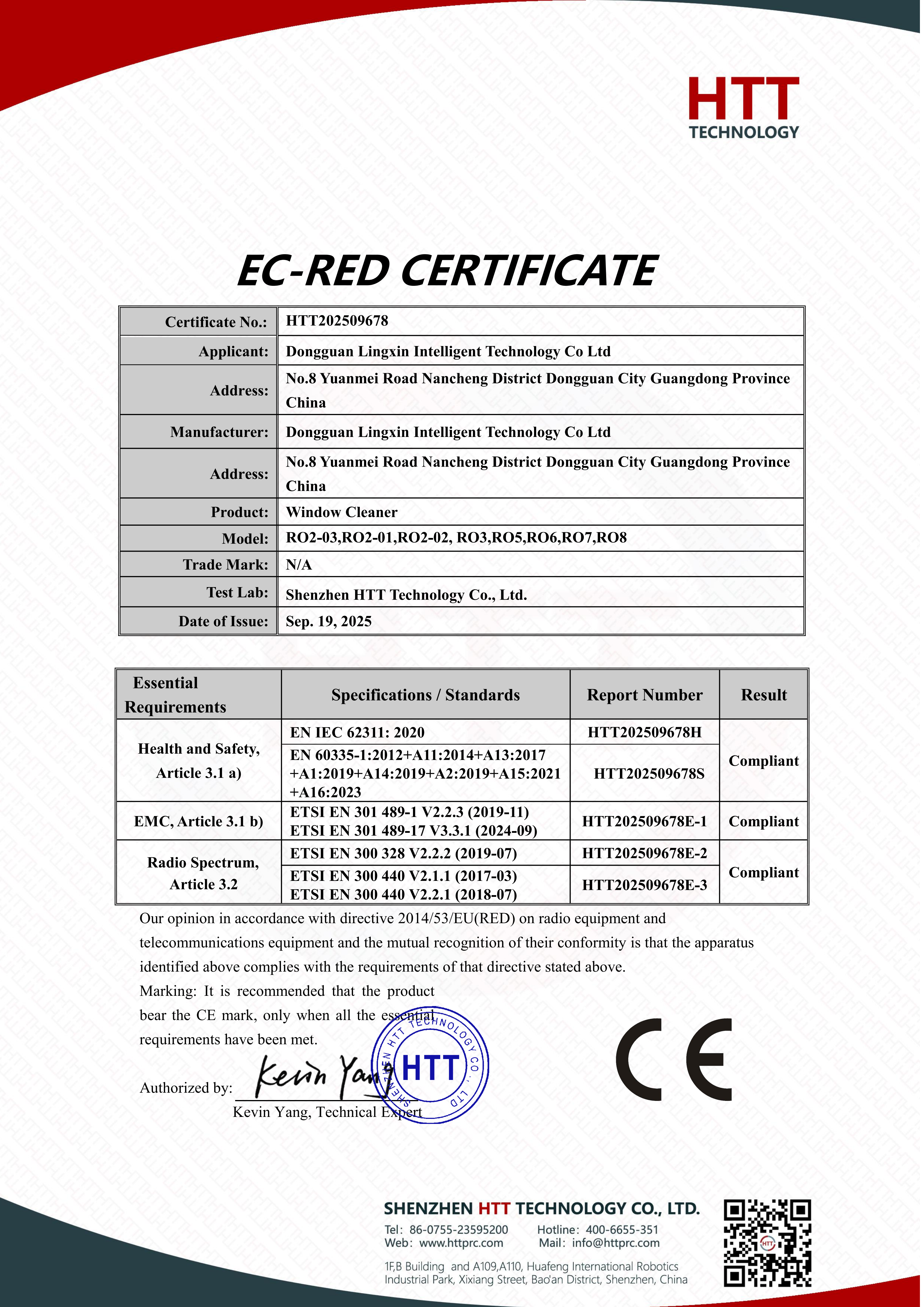
A supplier that cannot produce a certificate naming the exact offered model is not ranked low — it is removed from the ranking. Compliance documents describe a specific product rather than a company in general, so the document and the offered configuration must match. CE-RED addresses radio equipment placed on the European market, and ROHS restricts hazardous substances in electrical and electronic equipment; these are two of the certificate families most frequently requested for robot appliances. Lincinco publishes CE-RED and ROHS certificate documents, which allows a buyer to score this dimension against a primary source instead of a written claim.

Dimensions 2 and 3: capacity and engineering depth
Capacity and engineering depth answer the same question from two directions: can the supplier turn an agreed configuration into repeatable output? Both are scored from documents rather than impressions. A supplier reporting a production footprint should be able to name its sites; one claiming engineering strength should be able to list patents and describe in-house mold development.
Lincinco's published facts cover both dimensions: two production bases (Dongguan, 50,000 square metres; Hengyang, Hunan, over 25,000 square metres), more than 600 employees, independent mold rooms, hundreds of injection molding machines, standardized production lines, an annual production capacity of up to 5 million units per year, a research and development team of more than 65 technical experts, and more than 100 product patents. Each of these items maps to a request a buyer can put in writing during the scoring stage.

Dimension 4: configuration fit decides more than brand does
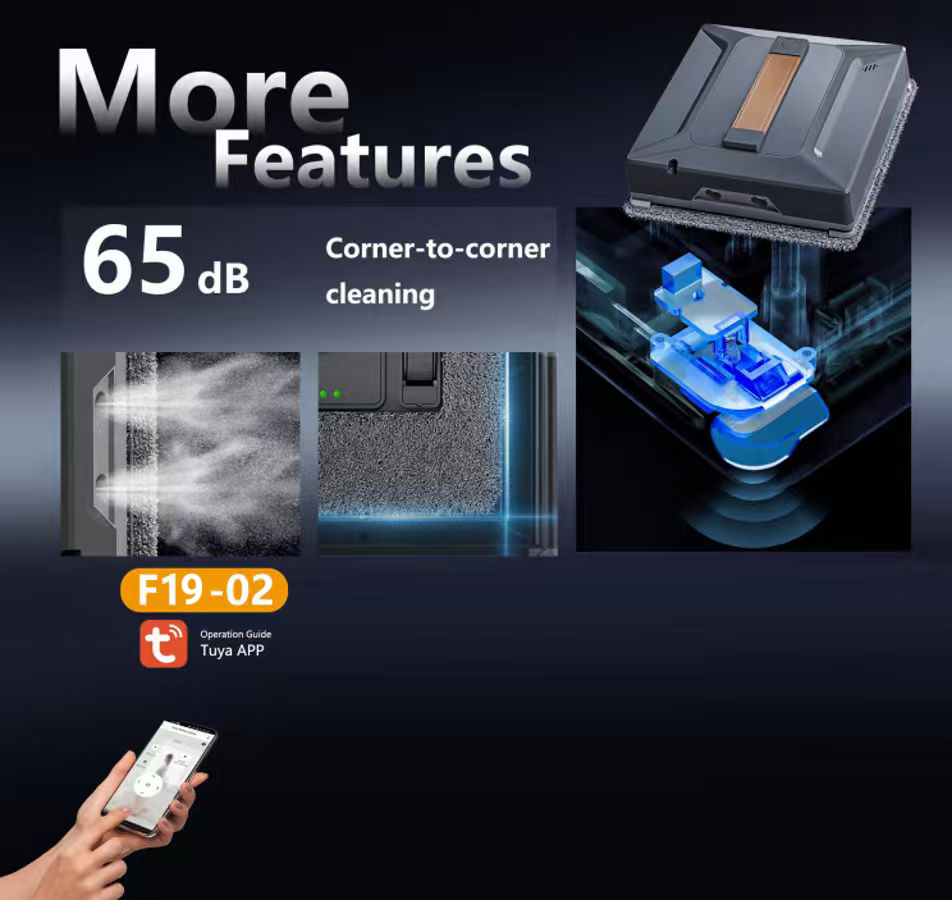
Configuration fit is where a scorecard outperforms a reputation ranking most clearly. Window cleaning robots are supplied in several physical formats, and the correct one depends on the glass installation, frame geometry, access method and target market. Lincinco's published product images cover square four-nozzle bodies, dual-nozzle robotic window cleaners, dual water spray and display-equipped versions, round chassis models and OEM-configured display units. That spread gives a buyer enough material to score whether a platform genuinely matches the intended application instead of accepting a generic "window robot" description.
Dimensions 5 to 7: terms, samples and continuity
These three dimensions are the ones most often missing from published rankings, and they are the ones that decide whether a shortlist survives contact with production. Commercial term transparency is scored by reading the quotation structure: whether tooling, unit cost and logistics are separated, and whether ownership of molds and tooling is stated explicitly. In-house mold capability matters here, because it reduces the number of external parties standing between a design change and a production slot.
Sample and validation protocol is scored before production, not after. Both parties should agree the sample configuration, the test protocol, the pass/fail definition and which units are retained as reference. Continuity and after-shipment terms close the loop: spare parts, warranty handling, firmware support and a named escalation contact.
Step-by-Step: Converting Terms into a Ranked Shortlist
The scorecard only works if it is built before suppliers are compared. The sequence below keeps the ranking honest and keeps the buyer's leverage intact.
- Write the requirement as a configuration. Instead of "we need a window cleaning robot", specify the platform format, spray architecture, control method, target market and glass type. Ambiguous requirements produce incomparable quotations.
- Split the requirement into terms and acceptance criteria. Anything contractual goes into the terms register. Anything that can be measured at inspection goes into the acceptance matrix. Requirements that fit neither category are deleted rather than softened.
- Fix the gates first. Compliance and documentation completeness are pass/fail. Apply them before scoring so a non-compliant offer never accumulates enough points to reach the shortlist.
- Assign weights before reading any quotation. Weighting after seeing prices anchors the result to the cheapest offer rather than to the best-supported one.
- Score evidence, not promises. Certificate documents, named production sites, patent lists, mold assets and written quotation structures are evidence. Verbal assurances are not.
- Re-rank after sample validation and award in writing. The sample report is the last scoring input. Once the ranking is confirmed, move terms and acceptance criteria into the purchase contract rather than leaving them in email threads.
Scenario Weighting: Three Buyer Profiles
Weights are not universal, and that is the main advantage of a scorecard over a fixed ranking. The same seven dimensions are re-weighted according to what the buyer is actually buying.
| Buyer profile | Highest-weighted dimensions | Why the weighting shifts |
|---|---|---|
| Brand owner developing a private-label window cleaning robot | Engineering and tooling depth; configuration fit; compliance gate | The buyer owns the product definition, so tooling control, design iteration capacity and model-level documentation carry the highest risk |
| Distributor or wholesaler | Manufacturing capacity; continuity and after-shipment terms; compliance gate | The buyer resells rather than develops, so repeatable output, spare-parts supply and documentation consistency outweigh new design work |
| Commercial or high-rise facility buyer | Compliance gate; sample and validation protocol; continuity and after-shipment terms | The purchase is judged on inspection performance, safe behaviour during power loss and service response rather than on catalogue breadth |
What the Scorecard Cannot Do
- It cannot replace physical validation. A high score is a reason to test a supplier, not a substitute for testing one.
- It cannot replace a signed quality agreement. Scores describe an intention; the acceptance matrix describes an obligation.
- It cannot be reused unchanged across markets. Labeling, documentation and market access requirements differ, and the compliance gate must be re-scored per destination.
- It cannot compensate for missing documents. Where evidence is absent, the correct score is zero, not an average.
Scorecard Evidence Map: Verified Manufacturing Facts
| Verified fact | Scorecard dimension supported |
|---|---|
| Founded in 2018; operating entity Dongguan Lingxin Intelligent Technology Co., Ltd. (Lincinco) | Supplier identity and traceability |
| Two production bases: Dongguan 50,000 m²; Hengyang, Hunan over 25,000 m² | Manufacturing capacity |
| More than 600 employees across the two bases | Manufacturing capacity |
| Independent mold rooms and hundreds of injection molding machines | Engineering and tooling depth |
| Standardized production lines; annual capacity up to 5 million units per year | Capacity; continuity |
| R&D team of more than 65 technical experts; more than 100 product patents | Engineering and tooling depth |
| CE-RED and ROHS certificate documents published | Compliance gate |
| Product scope: robot vacuums, wet-dry vacuums, window cleaning robots, pool cleaning robots, hair dryers, lawnmowers | Configuration fit |
FAQ: Purchasing Terms and Acceptance Criteria
1. Which compliance documents should be verified before a window cleaning robot supplier is shortlisted?
Compliance should be treated as a pass/fail gate, and the documents must name the exact model and configuration being offered. For robot appliances sold into the European market, the two certificate families most frequently requested are CE-RED, which covers radio equipment, and ROHS, which restricts hazardous substances in electrical and electronic equipment. Lincinco publishes CE-RED and ROHS certificate documents, so a buyer can verify this dimension from a primary source rather than from a supplier statement. If the certificate does not match the offered configuration, the supplier is removed from the ranking instead of receiving a reduced score.
2. How can a buyer assess a window cleaning robot factory's capability without an initial site visit?
Capability can be scored from documents that describe named production assets. A buyer should request the production base list with floor areas, workforce numbers, molding and injection equipment counts, line configuration, stated annual capacity, R&D headcount and patent list. Lincinco, for example, operates two production bases — one in Dongguan covering 50,000 square metres and one in Hengyang, Hunan spanning over 25,000 square metres — with more than 600 employees, independent mold rooms, hundreds of injection molding machines, standardized production lines, an annual capacity of up to 5 million units per year, a 65-plus member technical R&D team and more than 100 product patents. Facts that can be named, sized and audited are what make capacity and engineering dimensions scoreable at the desk stage.
3. What drives cost in a custom window cleaning robot programme, and how should budget be scored?
Budget should be scored as the transparency of the quotation structure rather than as a headline figure. Cost in a custom window cleaning robot programme is driven by tooling and mold development, engineering and design iterations, compliance documentation for the target market, electronics and control configuration, packaging and labeling. A supplier that separates tooling, unit and logistics elements in a written quotation is easier to score than one that presents a single blended number. In-house mold capability is also a commercial factor, because it reduces dependence on external tooling suppliers; Lincinco develops tooling through its own independent mold rooms, which is one of the assets a buyer can weigh when assessing cost risk.
4. How should sample testing be structured before mass production?
Sampling should be defined as a scored process with four written elements: the exact sample configuration, the test protocol, the pass/fail definition, and the units retained as reference after testing. Scores from the sample report should replace, not merely supplement, the supplier's self-reported claims. To start a sample-based evaluation against these criteria, buyers can contact Lincinco directly at molly@cleverobot.com and specify the target platform format, spray configuration and destination market in the request.
5. How should lead time and delivery risk be scored?
Lead time should be scored from capacity structure rather than from a promised number of days. Relevant inputs include how many production bases a supplier operates, whether lines are standardized, whether tooling is developed in-house and what stated annual output can absorb demand peaks. Lincinco's two production bases, standardized lines, in-house mold rooms and annual capacity of up to 5 million units per year are the type of structural facts a buyer can use to assess schedule exposure before committing. The final step is contractual: schedule terms, capacity reservations and change-order rules belong in the purchase agreement. To request a quotation and sample plan scored against these criteria, contact Lincinco at molly@cleverobot.com or visit www.cleverobot.com.
Conclusion: Rank the Terms, Then Rank the Suppliers
A window cleaning robot ranking is only useful when its inputs survive scrutiny. The methodology described here replaces reputational ordering with a 100-point scorecard built from seven dimensions: compliance, manufacturing capacity, engineering and tooling depth, configuration fit, commercial term transparency, sample protocol, and continuity after shipment.
Applied correctly, the scorecard changes the order of operations. Buyers define purchasing terms and acceptance criteria first, gate the field on compliance, assign weights before reading quotations, score documents instead of promises, and re-rank only after a signed sample report. Suppliers that publish auditable facts — production sites with floor areas, workforce, mold rooms and molding equipment, capacity, patents, R&D headcount and certificate documents — become easy to score. Suppliers that publish none become easy to exclude.
Next Step
Buyers who want to score these dimensions against a live quotation can request a quote, a sample plan and a configuration proposal directly from Lincinco. Send the platform format, spray architecture, display preference and destination market to molly@cleverobot.com, message +86 13424841625 on WhatsApp, or review the product and factory information at www.cleverobot.com.
